I sat in the third row of the Thang Long Water Puppet Theatre and watched a dragon breathe fire, a phoenix land on a lotus flower, and a fisherman catch a fish that fought back with the force of something real — all while the performers stood invisible behind a bamboo curtain, waist-deep in water, manipulating wooden figures on rods beneath the surface. Water puppetry is a Vietnamese invention from the 11th century Ly dynasty, born in the flooded rice paddies of the Red River Delta where farmers performed for each other between harvests. What happens at Thang Long today is the most refined version of that tradition — sixteen performers, a live orchestra playing dan bau and trong drums, and a 45-minute performance that tells the stories of Vietnamese village life, mythology, and imperial history simultaneously.
What Makes This Experience Special
- ✦Watch 1,000-year-old Vietnamese water puppetry at Hanoi's most celebrated venue
- ✦Live traditional orchestra with dan bau one-string instrument and trong drums
- ✦Iconic scenes including the Dragon King's court, the rice harvest, and the legendary Ho Hoan Kiem turtle
- ✦Performances daily at Thang Long Theatre on Dinh Tien Hoang Street, beside Hoan Kiem Lake
- ✦Post-show meet with performers who explain the hidden mechanics of rod-puppet operation
- ✦Best combined with an egg coffee evening at Cafe Giang on Nguyen Huu Huan Street
What Actually Happens Inside the Theatre
The stage is a waist-deep pool roughly 4 metres by 3 metres, with a painted backdrop depicting a traditional Vietnamese village. The "water stage" (nhà rối nước) is screened from the audience by a bamboo and fabric curtain — behind it, twelve to sixteen puppeteers stand in the water, manipulating their figures with bamboo rods and wire mechanisms they have spent years perfecting. The puppets are lacquered hardwood — waterproofed with layers of fig resin — and weigh between 2 and 15 kilograms. Moving them with the precision required while invisible, waist-deep in water, takes 4 to 7 years of training.
The performance itself is a series of short acts, each telling a different story: the rice farmer's daily life, a festival, legendary creatures from Vietnamese mythology. The most breathtaking act is the appearance of the Rong (dragon), a two-metre serpent that undulates through the water with astonishing fluidity, turns, and breathes actual fire from its mouth. The audience every single night makes the same sound at that moment — a collective intake of breath.
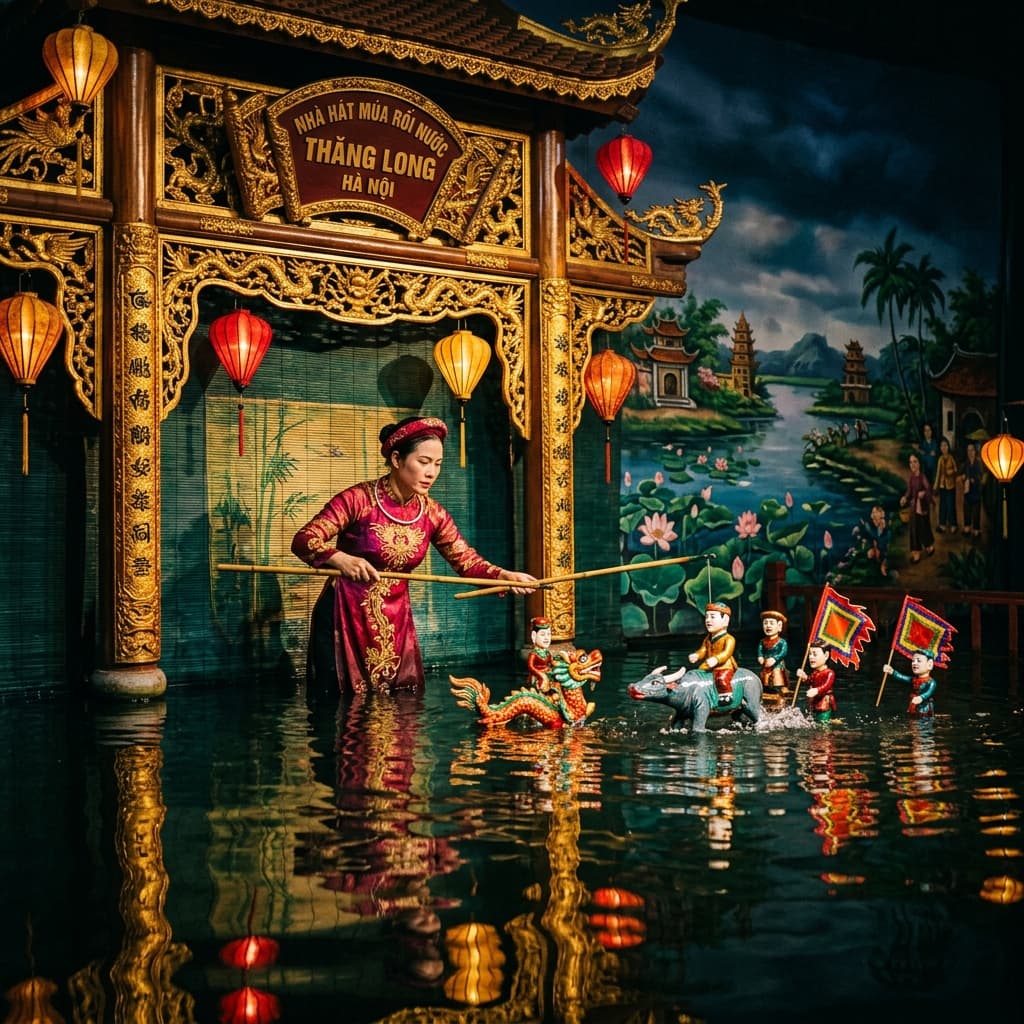
Thang Long Theatre has been performing nightly since 1969. The mechanics beneath the water surface remain a professional secret.
The History You Should Know Before You Go
Water puppetry (múa rối nước) was first documented in a stone stele inscription at Doi Son Temple in Nam Ha province, dated 1121 AD — during the reign of Emperor Ly Nhan Tong. The form originated in the flooded rice paddies of the Red River Delta where village performances were held on natural water stages. Each village in the delta had its own troupe and its own repertoire, kept secret from rival villages. The secrecy was so important that performers reportedly swore blood oaths not to reveal techniques to outsiders.
The Thang Long Water Puppet Theatre was established in 1969 in Hanoi and is the most prestigious in the country. It performs up to five shows a day during peak season. The theatre was named after the ancient name for Hanoi — "Thang Long" meaning "Ascending Dragon" — chosen by Emperor Ly Thai To in 1010 when he moved the Vietnamese capital there from Hoa Lu. Every element of that history is woven into the performance.
How to See It Without the Tourist Experience
The standard tourist approach is to book the cheapest ticket (around £5 for the rear stalls) and sit in a crowded row without context. The better approach: book the front-row seats directly with the theatre (about £10), arrive 20 minutes early to watch the orchestra warm up, and ask your private guide — who has almost certainly seen this dozens of times — to explain the symbolism of each act before it happens. The turtle that appears in the final act is not decorative: it represents the legendary sacred turtle of Hoan Kiem Lake, who retrieved the sword of Emperor Le Loi after the defeat of the Ming Chinese in 1428. The mythology runs deep.
After the performance, the performers come out for photographs. Ask your guide to translate a few questions — the puppeteers almost universally love talking about their craft and are deeply knowledgeable about the history. Hearing one of them describe a 30-year career in waist-deep cold water, performing nightly, with hands that have handled the same rod techniques thousands of times, gives the experience a completely different weight.