On the 14th day of every lunar month, Hoi An Ancient Town undergoes a transformation that has been repeating for four centuries. The electric lights go off. The streets fill with the glow of hundreds of silk lanterns hung from every building, floating in baskets on the Thu Bon River, carried by visitors and locals alike. The sound changes too — the motorbikes disappear, the music becomes traditional, and the narrow lanes of the Ancient Town fill with something that feels genuinely ancient, not reconstructed. I have been to many things billed as "the most magical night in Vietnam." This is the one that actually delivers.
What Makes This Experience Special
- ✦Every 14th day of the lunar month — typically once per calendar month
- ✦Release a floating flower lantern (đèn hoa đăng) on the Thu Bon River for luck
- ✦Walk the lamplit streets of the UNESCO World Heritage Ancient Town after dark
- ✦Visit the Japanese Covered Bridge — built in 1593 — under lantern glow
- ✦Watch traditional music and dance performed on the riverside stage
- ✦Browse the night market stalls selling hand-made silk lanterns from local artisans
What Actually Happens on Lantern Night
The festival begins at dusk, when the Ancient Town switches off its commercial lighting and the street lamps are dimmed. The transition takes about ten minutes — you're in a busy tourist town, and then, almost imperceptibly, you're somewhere else. The lanterns that every building hangs year-round finally do the job they're designed for: without electric competition, their glow is soft, warm, and sufficient to walk by. The market stalls set up along Nguyen Huu Huan Street sell hand-made silk lanterns, flower crowns, and the small floating lanterns — rice paper over a bamboo frame, with a birthday-cake candle inside — that you carry down to the river and release.
The river release is the emotional centre of the festival. You kneel at the bank, light the candle, say whatever you came here to say, and let the current take it. On a full festival night there can be five hundred lanterns drifting downstream simultaneously, each one a small orange star on the dark water. The Thu Bon River south of the Ancient Town is wide and slow, and the lanterns travel a long way before the candle finally burns out.
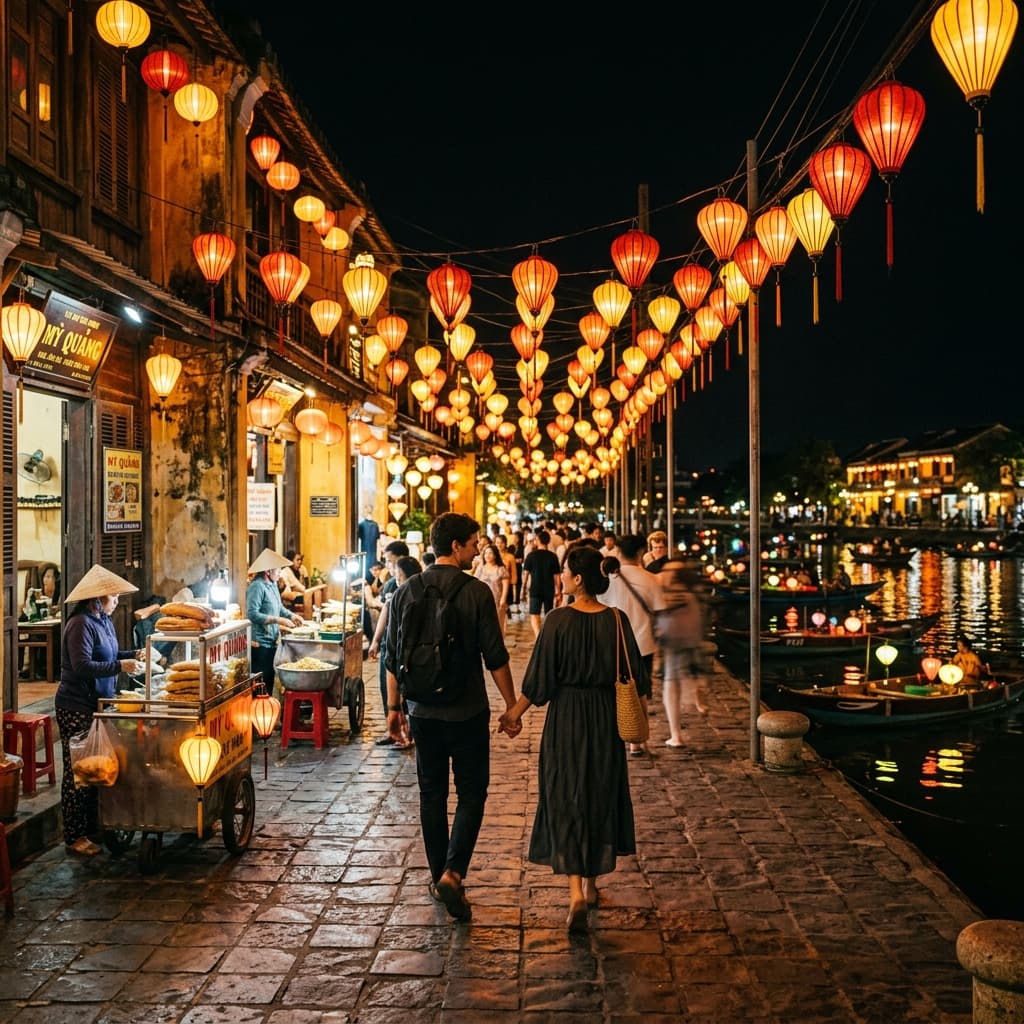
The Full Moon Festival on the riverfront. Every building in the Ancient Town hangs lanterns year-round; on festival night, they become the only light source.
The History Behind the Light
Hoi An was Vietnam's most important trading port from the 15th to 19th centuries, a meeting point for Chinese, Japanese, Dutch, Portuguese, and Indian merchants. The Japanese community was so significant that an entire quarter of the town was designated for Japanese residences — the Covered Bridge at the western end of the old town was built by Japanese merchants in 1593 to connect their quarter to the Chinese quarter across the canal. The lantern tradition is a synthesis of all these cultures: Japanese obon festival lighting, Chinese lunar calendar observance, and Vietnamese custom combined into something that belongs entirely to Hoi An.
The Ancient Town was designated a UNESCO World Heritage Site in 1999. Its extraordinary preservation — 1,107 monuments including merchant houses, assembly halls, temples, and the bridge — is partly explained by its economic decline in the 19th century when the Thu Bon River silted up and sea trade moved north to Da Nang. The town that modernity forgot became the town history preserved.
How to Do the Festival Without the Crowd
The festival attracts large numbers, and the central streets can become very congested between 8pm and 10pm. The intelligent approach is to arrive early — be in the Ancient Town by 5:30pm, find a riverside table at a café on Bach Dang Street, and watch the transition from day to festival-night from a fixed position with a drink in hand. The peak crowd density is on Tran Phu and Le Loi streets. The parallel streets one block south — Nguyen Thai Hoc and Bach Dang along the river — are quieter and, many would argue, more beautiful.
For the river lantern release, go to the riverbank on Le Loi Street rather than the more crowded Hoi An Riverside. The view downstream from there, with the Japanese Bridge visible in the distance and the lanterns floating between you, is the photograph that every travel magazine wants. It's also genuinely moving, regardless of how many times you've seen photographs of it.