If Ho Chi Minh City is the engine of modern Vietnam, the Mekong Delta is the country's heartbeat. The nine tributaries of the Mekong River fan out across the southernmost tip of Vietnam into an interlocking system of waterways so dense that from the air it looks like the veins of a leaf. Twenty-two thousand kilometres of canals connect 17 million people who live almost entirely by and on the water. Floating markets sell fruit piled in wooden boats. Houses on stilts line channels barely wide enough for a sampan. Children use boats the way city children use bicycles — to get to school, to the market, to each other's houses. Coming here from the cities of central or northern Vietnam is like arriving in a different country, operating according to entirely different laws.
What Makes This Experience Special
- ✦Float through Cai Rang Floating Market — the largest in the Mekong Delta, largest before 8am
- ✦Navigate the narrow back-canals of Ben Tre province by traditional wooden sampan
- ✦Visit a coconut candy workshop, a rice paper factory, and a honey bee farm on the same morning
- ✦Cross the Mekong by local ferry — the way 17 million Delta residents travel every day
- ✦Cycle through Vinh Long's fruit orchards and try 30 varieties of tropical fruit with a local family
- ✦Stay overnight on a river homestay and eat dinner with the fishing family whose boat is also their home
Cai Rang Floating Market: Early Morning or Nothing
The floating market at Cai Rang, six kilometres south of Can Tho on the Hau River, is the largest wholesale floating market in the Mekong Delta. Hundreds of wooden boats cluster together before dawn, each one loaded with a single product — watermelons stacked five deep, pineapples in nets, dragonfruit in towers — and a bẹo (a long pole with a sample of the cargo hanging from the end so buyers can identify the product from a distance). The market peaks between 5:30am and 7:30am. By 9am it's largely done.
Every travel guide tells you to go early. Almost no one actually does it — because getting from Can Tho to the market at 5:30am requires getting up at 4:45am, which tests even the most committed traveller. I did it twice. The first visit, I arrived at 7am and thought it was excellent. The second, at 5:30am, I understood it. In the pre-dawn dark with the market boats lit only by their own lanterns, everything moving on the water, the sound of the vendors calling and the boat engines and the river birds, the atmosphere is of something primeval and irreplaceable. UNESCO's representative body recommended Cai Rang for inclusion on the Representative List of the Intangible Cultural Heritage of Humanity in 2016.
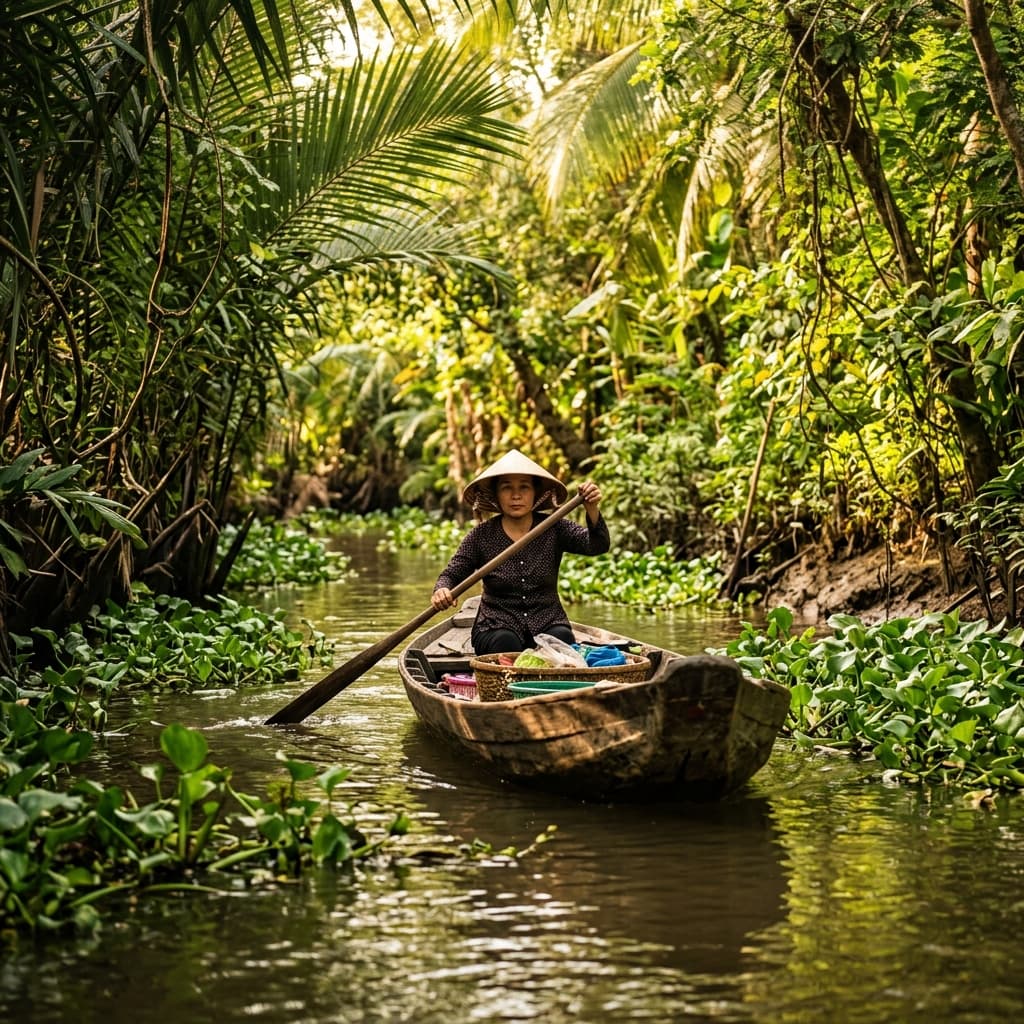
The back-canals of Ben Tre province. Roads here are an afterthought; the canals are the infrastructure.
Ben Tre Province: The Back-Canals That Most Visitors Miss
The standard Mekong day trip from Ho Chi Minh City goes to My Tho, sees one floating market, visits a honey farm and a coconut candy workshop on the same island, and turns around. The experience is not wrong, but it's the Mekong's lobby. The rooms beyond — the labyrinthine back-canal system of Ben Tre province — are where the actual substance lives.
Ben Tre is known as the "Land of the Coconut Palm." The province produces 40% of Vietnam's coconut output and the trees are everywhere — lining every canal bank, shading every house, providing the raw material for an industry that makes candy, oil, rope, cooking utensils, and roofing material. Navigating Ben Tre's back-canals by sampan with a local guide takes you through passages where the canopy meets overhead, the water turns dark green with reflected light, and you travel for twenty minutes without seeing any sign of the 21st century except the occasional solar panel on a house roof.
At the end of one canal is Nguyen Thi Thanh's home — a stilted house where she has been making rice paper by hand for forty years. She spreads the batter across a curved bamboo mat, steams it for ninety seconds over a clay pot, peels it off, and sets it on a bamboo rack to dry in the sun. The result is translucent, slightly chewy rice paper that bears no resemblance to the dried variety sold in Western supermarkets.
Homestay on the Water: Staying With a River Family
The Mekong Delta has excellent homestay accommodation — families who take guests into their river houses, feed them from their own garden and fishing catch, and treat the experience as genuine hospitality rather than a commercial transaction. The best are in Vinh Long province, where the homestay culture has been developing since the late 1990s and the families have learned to provide comfortable accommodation without losing the authenticity that makes the experience meaningful.
At Ut Trinh's homestay on An Binh Island, you sleep in a room above the river on a wooden platform that sways slightly with the current. Dinner is whatever was caught or harvested that day — catfish from the river, morning glory from the garden, green papaya salad, rice from the family's own paddies. After dinner, Ut's husband Mr. Thanh sits on the platform with a bottle of rice wine and tells stories — about the American War, about the floods of 2000 when the water rose two metres above this platform, about his daughter who now lives in Ho Chi Minh City and works in a phone repair shop. The gap between his world and hers, across sixty kilometres of Delta water, is one of the most quietly startling things I encountered in Vietnam.